
Winston County Criminal Court Records
The Winston County Circuit Clerk is the official record keeper and business manager for District and Circuit Court proceedings. Once a prosecutor files a criminal case, the clerk's criminal division preserves the pleadings, court settings, orders, case action summary, financial entries, and final result. The file can show allegations that never became convictions, so each charge must be read together with its current status and disposition. For a closer look at the arrest-to-filing stage, use the contextual explanation of Winston County arrest records and court charges.
Winston County is part of Alabama's Twenty-Fifth Judicial Circuit. District Court handles misdemeanors, traffic matters, preliminary felony hearings, and some non-capital felony guilty pleas before indictment. Circuit Court is the general-jurisdiction court for felonies and also hears misdemeanors or ordinance violations that arise from felony cases. A felony can therefore appear first in a District Court record for an initial appearance, bond issue, or preliminary hearing, then continue in Circuit Court after indictment or transfer.
The official Winston County court page identifies the Winston County Courthouse record hub, where Circuit Clerk J.D. Snoddy maintains the trial-court files. Sheriff Caleb Snoddy leads the Sheriff's Office, which maintains the separate law-enforcement side of an arrest or incident. Those offices should not be treated as interchangeable custodians.
Search Winston County Criminal Records
Alacourt ACCESS, also called Just One Look, provides statewide on-demand access to Alabama trial-court records one case at a time. It lists criminal records among its covered categories. The public workflow offers name and case-number searches. Each search costs $9.99, including a no-match search. Available document images cost $5 for the first 20 pages and $0.50 for each later page. A case-detail report can include basic case information, status, court actions, settings, parties, financial history, and a detailed action summary.
- Open Just One Look and choose a name search or case-number search.
- Enter the defendant's name or a valid Alabama case number and complete the paid workflow.
- Confirm that the result names Winston County and the correct District or Circuit Court case.
- Read the charge entries, settings, case action summary, disposition, and financial history as separate fields.
- Call or visit the Circuit Clerk when the record is absent, an image is unavailable, or a certified copy is needed.
Professional users may instead use the Alacourt subscription login with a customer ID, user ID, and password. People who do not want to use paid online access can contact the Circuit Clerk at (205) 489-5533 or visit the clerk at 10 Blake Drive in Double Springs during public hours. The office is open Monday through Friday, 8:00 a.m. to 4:30 p.m., and closes from noon to 1:00 p.m. The clerk can explain record and copy procedures but cannot give legal advice.
Winston County Criminal Case Flow
The case action summary is a dated history of what the court did. In Winston County, early felony steps may occur in District Court before the matter reaches Circuit Court. An indictment is a formal grand-jury felony charge. Arraignment is the hearing where charges are stated and a plea is entered. Motions ask the judge to act, while orders record the judge's rulings. A disposition states the outcome. Sentencing follows a conviction and may record incarceration, probation, restitution, fines, costs, or other conditions supported by the case.
Case flow: Charges Filed → Arraignment → Pretrial and Motions → Plea or Trial → Disposition → Sentencing
| Stage | What Happens |
|---|---|
| Arraignment | The defendant hears the filed charges and enters a plea. |
| Pretrial and motions | Parties file requests, the court sets hearings, and the judge enters rulings. |
| Plea or trial | The charge may be resolved by plea, dismissed, or decided at a bench or jury trial. |
| Disposition | The record states the outcome for each charge, not just the case as a whole. |
| Sentencing | After conviction, the court enters punishment, costs, restitution, probation, and related terms. |
The local docket archive illustrates the kinds of settings that can become case entries, including arraignment, plea day, preliminary hearing, bench trial, jury trial, and show-cause or failure-to-pay dockets. A posted calendar is not the full criminal file. Confirm any current hearing with the clerk because the case record and court notice control.
What Winston Criminal Records Show
One Winston County criminal record may contain several charges and a separate result for each. The court field identifies whether District or Circuit Court handled the entry. Setting dates show scheduled events, while court actions and rulings show what actually occurred. Financial history can list bond, court costs, restitution, payments, balances, and disbursements. Images or attachments may be available for a separate portal charge when the document has been scanned.
| Field | What It Shows |
|---|---|
| Case number | The identifier used for an exact Just One Look search and clerk request. |
| Defendant and parties | The accused person and other parties identified in the case. |
| Court and judge | The District or Circuit Court and the judicial officer tied to an event. |
| Charges | The filed offenses, which may later be amended, dismissed, or resolved. |
| Settings and actions | Hearing dates, motions, orders, rulings, pleas, and trial events. |
| Disposition | The final outcome for a charge, such as guilty, not guilty, or dismissed. |
| Sentence and finances | Punishment, probation, restitution, costs, payments, and balances recorded by the court. |
Winston Charges and Convictions
A charge is an accusation. A conviction is a finding or plea of guilt. Winston County criminal records can preserve charges that were amended, dismissed, no-billed, or followed by acquittal, so the existence of a charge entry cannot establish guilt. Read every count through its final disposition. If a result is unclear, request the relevant order or certified disposition from the Circuit Clerk instead of drawing a conclusion from a case caption alone.
| Charge | Conviction | |
|---|---|---|
| Stage | Accusation | Verdict or plea |
| Meaning | A filed accusation | A guilty plea or finding |
| Where to verify | Charging document and later amendments | Disposition, judgment, and sentence entries |
The ALEA registry service page illustrates a separate state public-safety record channel.
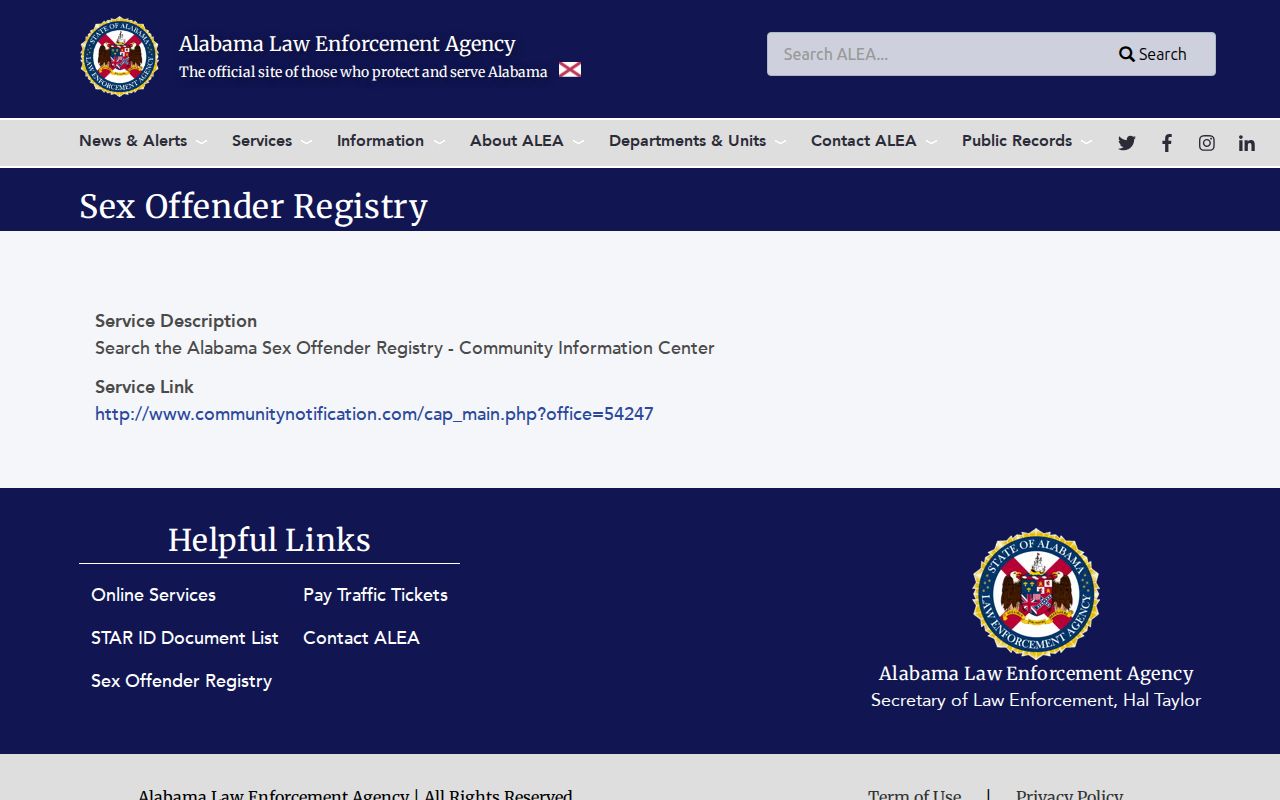
A registry is not the Winston County criminal case file and must not be used as a substitute for the court's charge, disposition, or sentence entries.
Read Winston County Case Outcomes
Disposition means the outcome of a case or charge. Common plain-language outcomes include guilty, not guilty, dismissed, transferred, or appealed. The action summary may also show a plea setting or an order without yet showing a final result. A pending status means the case has not reached a recorded final disposition. Sentence information should be read only after a conviction entry and may include separate terms for custody, probation, restitution, fines, costs, or other conditions.
Financial history is not the same as punishment. A balance can include court costs and other assessed sums, while bond is security or a release condition before final resolution. Restitution is payment ordered for loss tied to the offense. When several charges are present, the record may show a different disposition and sentence for each count. For the broader inventory of civil, domestic, probate, and other files, see Winston County court records.
Winston Criminal Records Access Limits
Sealing restricts public access by court action. Expungement is the Alabama process for removing qualifying criminal records from public access under Chapter 15-27. Neither result should be assumed from a failed name search. Eligibility is not automatic and depends on the charge, disposition, and statutory category. A person considering a petition should gather the case number, arresting agency, charge, and disposition, then ask the Circuit Clerk about filing logistics or consult an attorney about eligibility.
| Sealed | Expunged | |
|---|---|---|
| Public visibility | Restricted by court order | Qualifying records removed from public access |
| Authority | The court's sealing order | Alabama Code Chapter 15-27 and a granted petition |
| Agency access | May remain available as the order allows | Limited nonpublic court or law-enforcement access may remain |
The official Alabama expungement eligibility statute is the starting point for qualifying categories.
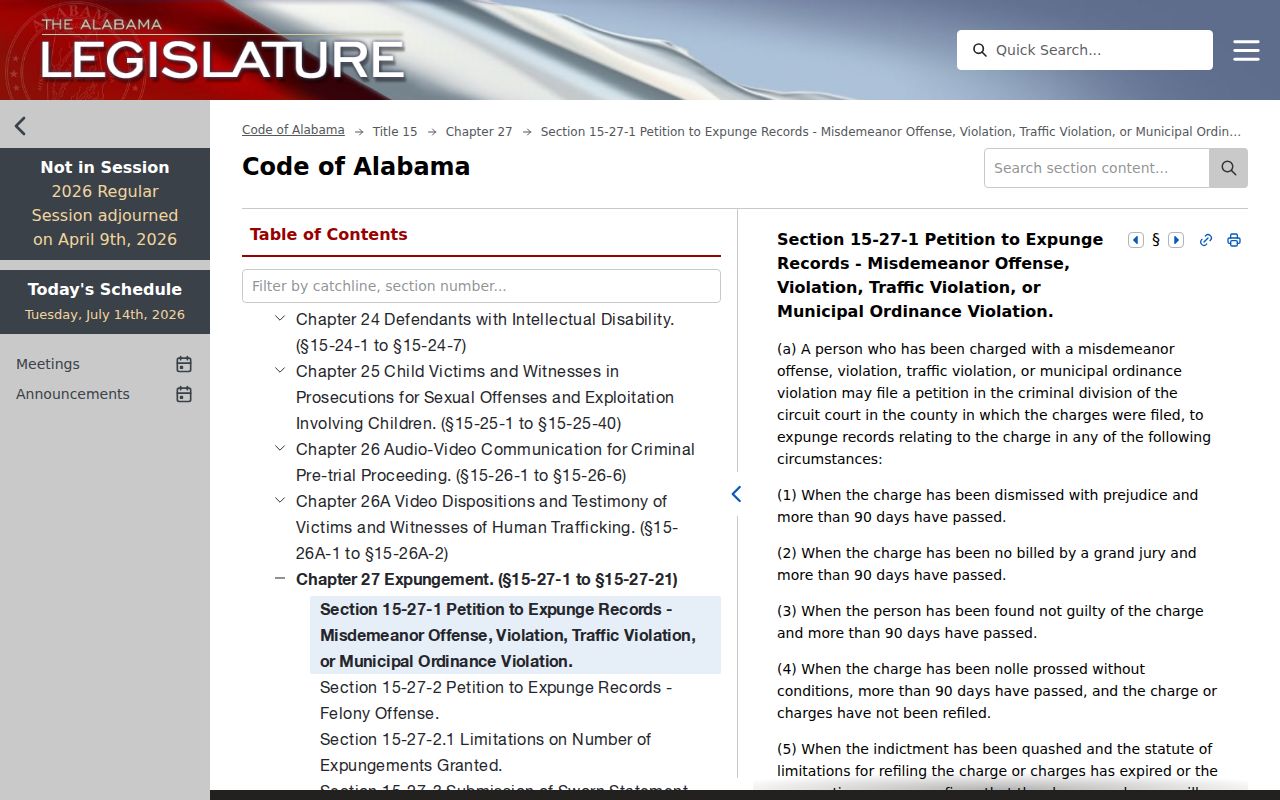
The statute supplies legal criteria; the clerk's file supplies the local charge and disposition facts needed to assess a Winston County matter.
Public Winston County Criminal Records
Alabama Code Section 36-12-40 gives residents a right to inspect and copy public records unless another law supplies an exception. Section 36-12-41 addresses copies and certified copies and permits lawful fees. These rules do not override confidentiality statutes or court orders. The correct local custodian for District and Circuit criminal files is the Winston County Circuit Clerk.
Key Statutes:
Alabama Code § 36-12-40 supports inspection and copying of public records, subject to legal exceptions.
Alabama Code § 36-12-41 supports copies and certified copies from the lawful custodian.
Online reports are convenient but may omit a document image or a restricted entry. A certified court copy comes from the clerk, not from a search result. Mail inquiries may be directed to P.O. Box 309, Double Springs, AL 35553 after confirming copy requirements with the office.
Note: The Circuit Clerk can provide procedure and copy information but cannot interpret a criminal record or offer legal advice.
Restricted Winston Criminal Court Records
Alabama Code Section 12-15-133 restricts juvenile legal records. Juvenile delinquency, dependency, and related proceedings are not ordinary public criminal files. Sealed cases and granted expungements may disappear from public results or display only limited docket data. Active investigations and sealed indictments can also remain unavailable. Personal identifiers such as Social Security numbers, financial account numbers, minor names, victim information, and protected addresses or medical facts may be redacted.
The official juvenile-confidentiality provision shows why public access has firm boundaries.
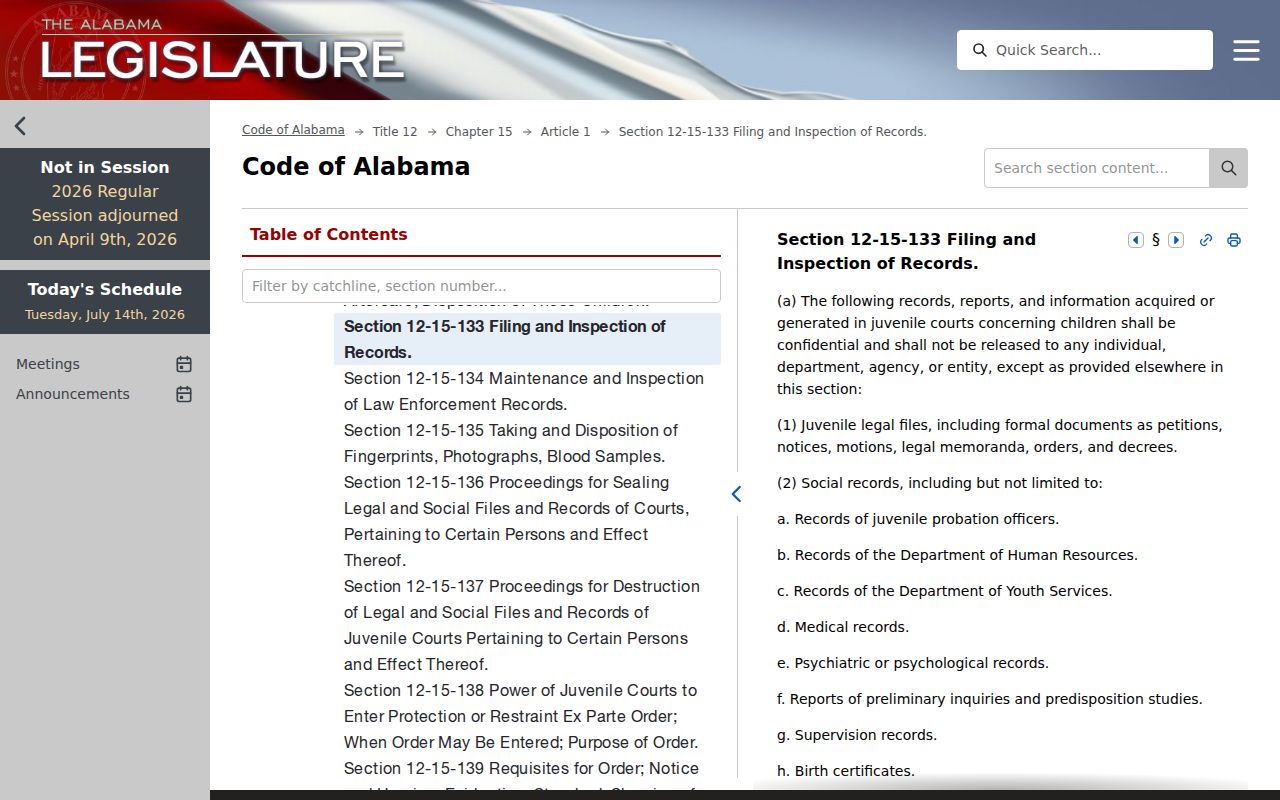
A restricted result should be handled through the court and lawful process, not through an unofficial database that claims to reveal sealed material.